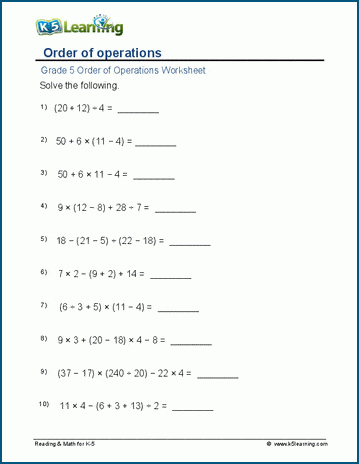
Math Question Order Of Operations. Translating verbal expressions into equations; Start with calculations inside brackets or parentheses.
Grade 5 Pemdas Worksheets | K5 Learning from www.k5learning.com
In math, order of operations are the rules that state the sequence in which the multiple operations in an expression should be solved. Ten based system and place value; I tweeted about this in september 2017 when my students completed it, but it somehow managed to never end up on the blog here.
With That Version Of The Rules, Which Is Still Taught In Many Schools, The Answer Would Be 1.
According to pemdas, the first thing to do is parenthesis. Pick the correct sequence of steps for order of operations: In mathematics, we do basic operations like addition, subtraction, multiplication and division.
Kindly Mention The Details Of The Error Here.
We use an “order of operations” rule we memorized in childhood: They try to follow pemdas by multiplying 2 and 3 to get 6. A comprehensive database of more than 20 order of operation quizzes online, test your knowledge with order of operation quiz questions.
Then, Solve Multiplications And Division, From Left To Right.
Our online order of operation trivia quizzes can be adapted to suit your requirements for. This is recognized in pema which more correctly shows that there are four levels. Here's a full explanation of the answer.
Parenthesis, Exponents, Division And Multiplication (Performed Left To Right), Addition And Subtraction (Performed Left To Right).
To help students in the united states remember this order of operations, teachers drill the acronym pemdas into them: This order of operations question stack features 10 questions that include absolute value bars and radicals. Answer choices parentheses, multiplication/division, addition/subtraction, brackets, braces
Translating Verbal Expressions Into Equations;
See how you understand this lesson. Half of the answers say the correct answer is 7 as you do the order of operations with multiplication and division first giving you: Hence, 2 (1/x) (1/x)+ 5 (1/x) + 3 = 0.