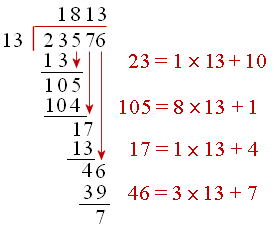
Division Equations Examples. You might have some equations that require subtraction, then division to solve, or an equation that requires multiplication, then division to solve. Some of the division examples are given below:
3. Division Of Algebraic Expressions from www.intmath.com
Special names for each character in division. Each part involved in a division equation has a special name. \(a \div b\) & \(\frac{a}{b}\) so the division formula is:
Division Formula \({\Bf{Dividend}} = {\Bf{Divisor}} \Times {\Bf{Quotient}} + {\Bf{Remainder}}.\) After Division, We Can Put All The Values In The Formula To Verify Or Check Whether Our Division Is Correct Or Not.
For example, 1/3 is 1÷3. We use division to solve equations which contain multiplication. For example, if we divide 4 into 2 slots, we can find out how.
The Integral Quotient Rule Is The Way Of Integrating Two Functions Given In Form Of Numerator And Denominator.
4 + 3 x = 1 6. Using division formula, dividend / divisor = quotient (500/50) = 10 = 10. When we know a multiplication fact we can find a division fact:
Partitive Is Used When Dividing A Number Into A Known Number Of Slots.
\(dividend \div divisor=quotient\) or \(\frac {dividend}{divisor} = quotient\) special cases. The formula below divides the. The horizontal line was introduced by arabs and used by european mathematicians in the 13th century.
( 3 9)3 2 ( 2) X X X X + + + + Write The Question In Long Division Form.
X3 divided by x equals x 2. Math explained in easy language, plus puzzles, games, quizzes, videos and worksheets. It was officially first […]
& Cubic Equations Polynomial Long Division Example One Polynomial May Be Divided By Another Of Lower Degree By Long Division (Similar To Arithmetic Long Division).
The formula for the integral division rule is deduced from the integration by parts u/v formula. The division is split into two parts i.e., partitive and quotative models. (the denominator is the number that we are dividing by, so if we multiply by that number, then we will end up with a coefficient of 1.) remember the denominator is the bottom number of a fraction.